Feb
15
Solar Powered Hydrogen Production
February 15, 2010 | 37 Comments
The need for free hydrogen in industry and fuels is huge and the potential when a low cost method arrives, staggering. Methane is nothing more than a carbon atom and 4 hydrogen atoms, so any production that comes up with hydrogen at low cost is going to be a breakthrough. Professor Thomas Nann and colleagues at the University of East Anglia in Norwich, UK may have it. They have a new technique that can convert 60 per cent of sunlight energy absorbed by an electrode into the inflammable fuel. And that’s just the discovery rating.
Nann is saying in a New Scientist article, “In fact the 60% figure is probably a worst-case scenario. This is still a preliminary study.” At 60% performance, 20% work efficiency from the hydrogen would yield 12%, as good as affordable photovoltaic solar cells. Run it through an 80% efficient fuel cell and that’s 48%, a dream for photovoltaic.
This can be a truly disruptive technology. Hydrogen can be stored for short terms. One could just burn it inside a facility or home, as the effluent is only water vapor. The technology boffins of Britain have to be mighty proud today.
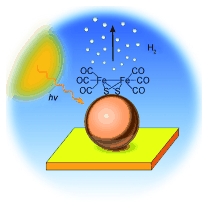
Photon Powered Solar Hydrogen Production Element. Click image for more info.
To generate the gas a gold electrode with a special coating is dipped into water and exposed to light. Clusters of indium phosphide 5 nanometers wide on its surface absorb incoming photons and pass electrons bearing their energy on to clusters of a sulfurous iron compound. This material combines those electrons with protons from the water to form gaseous hydrogen. A second electrode – plain platinum this time – is needed to complete the circuit electrochemically.
The all-inorganic method solves the organic material issue of short life spans. The inorganic materials used in the Nann system are more resilient. The first generation proof of concept is “a major breakthrough” in the field, they say, thanks to its efficiency of over 60% and the ability to survive sunlight for two weeks without any degradation of performance.
Nann describes that the high efficiency is largely thanks to the indium phosphide clusters being better at grabbing photons than organic molecules. “Think of them as a butterfly net for catching photons.”
Nann explains in using a standard measure of the probability that a material will absorb a photon that hits it, each cluster is 400 times better at netting photons than the organic molecules used in previous systems. “That’s why it works so well,” he says.
The team now plans to refine the system, including lowering the cost by making it with less expensive materials. “There is no major reason for using gold or platinum,” he said. The chosen materials were used simply because they are common in the laboratory. The other potential materials may be better. For certain the gold and platinum used need replacements.
As New Scientist is noting, others have welcomed the announcement. Vincent Artero at the Joseph Fourier University in Grenoble, France is quoted saying, “It’s a significant result, my overall appreciation of this work is highly positive, both regarding the scientific level and the promises that are held by the new result.”
Licheng Sun at the Royal Institute of Technology in Stockholm, Sweden, agrees. “It will certainly [provide] future research topics for water splitting,” he said.
For those of you interested in the published paper, it’s at Angewandte Chemie International, DOI: 10.1002/anie.200906262.
There are all the questions of scaling up, commercial production matters, costs to install, and a wealth of other milestones to cross before one might put a kit on the roof. But the energy input, solar energy is still free, and without organics the lifespan should be quite long. If this pencils out as a disruptive technology it could get very widespread very fast indeed.
Hydrogen used quickly, or bound up with carbon has immense value. We’re witnessing one more step in a chain from sunlight to powered work. Just how sunlight gets to heating, cooling and moving us isn’t so important as what it costs. The Brits look to be on to something, lets hope it works out and quickly.
Congratulations, too! When someone does the math on the “yield” per square meter there’s going to be a lot more news about this.
Comments
37 Comments so far
Feedburner
Reddit

Stumbleupon


[…] Solar Powered Hydrogen Production | New Energy and Fuel […]
[…] Solar Powered Hydrogen Production | New Energy and Fuel […]
[…] Solar Powered Hydrogen Production | New Energy and Fuel […]
[…] Solar Powered Hydrogen Production | New Energy and Fuel […]
Please tell me one thing. I am very confused – how much hydrogen is created by a single solar panel????
[…] Solar Powered Hydrogen Production | New Energy and Fuel Share and […]
[…] Solar Powered Hydrogen Production | New Energy and Fuel […]
[…] original here: Solar Powered Hydrogen Production | New Energy and Fuel Share and […]
[…] this article: Solar Powered Hydrogen Production | New Energy and Fuel Share and […]
[…] the original post here: Solar Powered Hydrogen Production | New Energy and Fuel Share and […]
[…] Solar Powered Hydrogen Production | New Energy and Fuel […]
The informative summary helped me very much! Saved your blog, extremely great topics everywhere that I read here! I appreciate the information, thank you.
Great blog for sure !
i try to readalmost everything about solar energy i find online.. i really enjoyed this one..thanks
Thanks for an idea, you sparked at thought from a angle I hadn’t given thoguht to yet. Now lets see if I can do something with it.
Great site. A lot of useful information here. I’m sending it to some friends!
I truly enjoy looking at this site, it has superb content.
Very interest blog, I will be back again.
Ive been wanting for a year to get onboard the green energy train,and i can’t seem to find a decent resource about solar panels,the homemade kind,don’t have the cash for hiring pros
Sites we Like……
[…] Every once in a while we choose blogs that we read. Listed below are the latest sites that we choose […]……
Check this out…
[…] that is the end of this article. Here you’ll find some sites that we think you’ll appreciate, just click the links over[…]……
Read was interesting, stay in touch……
[…]please visit the sites we follow, including this one, as it represents our picks from the web[…]……
Superb website…
[…]always a big fan of linking to bloggers that I love but don’t get a lot of link love from[…]……
Related……
[…]just beneath, are numerous totally not related sites to ours, however, they are surely worth going over[…]……
Great website…
[…]we like to honor many other internet sites on the web, even if they aren’t linked to us, by linking to them. Under are some webpages worth checking out[…]……
Hi! Someone in my Facebook group shared this website with us so I came to give it a look. I’m definitely enjoying the information. I’m bookmarking and will be tweeting this to my followers! Wonderful blog and outstanding design and style.
Recommended websites…
[…]Here are some of the sites we recommend for our visitors[…]……
Cool sites…
[…]we came across a cool site that you might enjoy. Take a look if you want[…]……
Great website…
[…]we like to honor many other internet sites on the web, even if they aren’t linked to us, by linking to them. Under are some webpages worth checking out[…]……
Visitor recommendations…
[…]one of our visitors recently recommended the following website[…]……
You are so awesome! I don’t believe I have read through anything like this before. So great to find another person with genuine thoughts on this topic. Really.. many thanks for starting this up. This website is one thing that is required on the web, someone with some originality!
When I originally commented I clicked the “Notify me when new comments are added” checkbox and now each time
a comment is added I get three e-mails with the same comment.
Is there any way you can remove me from that service?
Appreciate it!
Link exchange is nothing else but it is simply
placing the other person’s web site link on your page at proper place and other person will also do same in favor of you.
Appreciating the commitment you put into your blog and in depth information
you provide. It’s awesome to come across a blog every once in a while that isn’t the same unwanted
rehashed information. Wonderful read! I’ve bookmarked your site and I’m
including your RSS feeds to my Google account.
Hi there! I just wanted to ask if you ever have any trouble with hackers?
My last blog (wordpress) was hacked and I ended up losing
months of hard work due to no data backup. Do you have
any methods to protect against hackers?
Great blog! Do you have any recommendations for aspiring writers?
I’m planning to start my own website soon but I’m a little lost on everything.
Would you propose starting with a free platform like WordPress or go for a paid option?
There are so many options out there that I’m totally confused .. Any suggestions? Thanks a lot!
I like what you guys tend to be up too. This sort of clever work and coverage!
Keep up the wonderful works guys I’ve you guys to blogroll.
Hi! I hope HHO. I a dry cell; 12pcs 4 4 stainless steel plteas. connections I tried (+)(-)(n) .. (+)(n)(-). I used plain water water sea salt. Water sea salt produces a lot HHO unit keeps heating up. water acceptable out doesn’t heats up. I connect unit car directly 12volt battery. suggestions reduce heat? many positives negative connections ?