Nov
5
Here Come the Japanese Nuclear Reactors
November 5, 2009 | 29 Comments
Making the latest news is the new design from Toshiba is the 4S. The four ‘S’s are for super, safe, small and simple. The design is such that the tendency to call sealed reactors batteries applies as well.
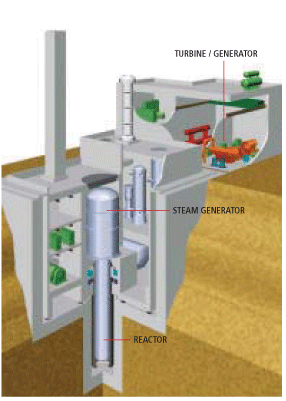
Toshiba 4S Graphic
The technical specifications for the 4S reactor are unique in the nuclear industry. The actual reactor would be located in a sealed, cylindrical vault 30 m (98 ft) installed underground, while the building above ground would be only 22 x 16 x 11 m (72 × 52.5 x 36 ft) in size. This power plant is designed to provide 10 MW of electrical power. It’s not a big reactor when sized up to those 1800 MG proposals.
The 4S is a fast neutron reactor using neutron reflector panels around the perimeter to maintain neutron density. The reflector panels replace complicated control rods, while still keeping the ability to shut down the nuclear reaction in case of an emergency. Toshiba’s 4S utilizes liquid sodium as a coolant, allowing the reactor to operate 200 degrees hotter than by using water. Using sodium allows the reactor to be unpressurized, even though water at such temperatures would run at thousands of pounds per square inch.
The 4S reactor is expected to provide electric energy for between 5 and 13 cents/kWh, factoring in only the operating costs, to which unknown decommissioning and fuel waste processing and safe disposal costs need to be added. On paper, it has been determined that the reactor could run for 30 years without being refueled.
The Toshiba 4S Nuclear Battery is already being proposed as the power source for the remote Galena Nuclear Power Plant in Galena, Alaska.
Toshiba is the parent company for Westinghouse whose AP1000 is working through its revisions needed to get the original certification from the Nuclear Regulatory Commission back in force. Thus Toshiba has some expertise for an application attempt employed now. News is expected any day for the formal application to be submitted. Toshiba’s staff had at last report met with the NRC back on August 8, 2008, at which time the NRC’s staff met for a pre-application presentation of a Phenomena Identification and Ranking Table (PIRT) for the 4S reactor.
Still in the starting blocks is the Fuji Molten Salt Reactor (FMSR). FMSR is a Japanese design that can run on thorium or a mix of thorium and Uranium or Plutonium. The project plan is to take 6 or 7 more years to develop a miniature FMSR. The R&D is mostly related to the details of the structural material and components.
In a molten salt reactor the fuel is a molten mixture of say, lithium and beryllium fluoride salts with dissolved enriched uranium, thorium or uranium-233 fluorides. The core consists of an unclad graphite moderator arranged to allow the flow of salt at some 700°C and at low pressure. The heat is transferred to a secondary salt circuit to be transferred by a heat exchanger to water and on to steam. These are not fast reactors, but with some moderation by the graphite they are epithermal (intermediate neutron speed).
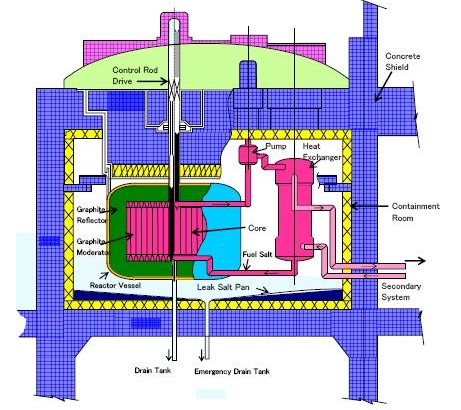
FUJI FMSR Primary System View. Click image for the largest view.
The fission products dissolve in the salt and are removed continuously in an on-line reprocessing loop and replaced with thorium-232 or uranium-238. Essentially refueling as they run. The actinides remain in the reactor until they fission or are converted to higher actinides for fission. A full-size 1000 MWe MSR breeder reactor was designed but not built. In 2002 a thorium MSR was designed in France with a fissile zone where most power would be produced and a surrounding fertile zone where most conversion of Th-232 to U-233 would occur.
The Fuji design fits the IAEA definition of a small reactor that generates less than 300 Mwe. There is worldwide interest to develop smaller units in reactor designs due partly to the high capital cost of large nuclear power reactors generating electricity via the steam cycle and in part to considerations of the public’s perceptions. Small reactors may be built independently or as modules in larger complexes, with capacity added incrementally as required. Economies of scale are provided by the larger number of reactors produced.
Also in the running is Mitsubishi Heavy Industries with an advanced High Temperature Engineering Test Reactor. Mitsubishi is going straight to developing hydrogen production technology for the multi-purpose use of the high temperature gas-cooled reactor, and the helium gas turbine direct power generation system for high efficiency power generation. Mitsubishi believes these technologies will be the key to the future commercialization of high temperature gas-cooled reactors.
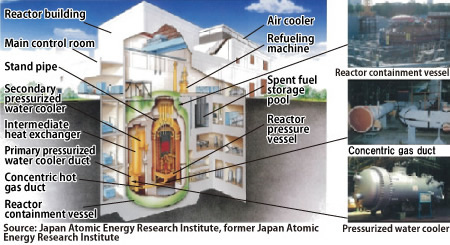
Mitsubishi Reactor Layout. Click image for the largest view.
Hitachi is going for Advanced Boiling Water Reactors in the smaller sizes. Already a partner with GE an others outside for the U.S., Hitachi draws on great resources. The designs are ranging from 400 MW electric on up to near 1400 MWe.

Hitachi Reactor Cutaway View
Hitachi’s designs differ in that is that the boiling water reactors (BWR) operate at a lower pressure than the pressurized water reactors (PWR). Even though the BWRs are highly pressurized (1000 – 1100 psia), they operate at only half of the pressure found in PWRs. The lower pressure in the BWRs allows the water circulating through the core to boil resulting in a mixture of water and steam surrounding the reactor core. Since steam does not carry heat away from the reactor core nearly as well as water, advanced BWRs are always monitored and attempting to maintain a certain amount of water circulating in the reactor core to prevent overheating. Not simple engineering, but this reactor’s waste stream is nearly a fast breeder reactor of plutonium if that’s the way a buyer wants to go.
The 4S looks to be coming to the U.S. market, and has started procedures for approval in the United States, the Nikkei business daily said. Fuji has a way to go in R&D. Mitsubishi’s marketing plans are still essentially inscrutable. Hitachi has a list of partners and may well see sales in Asia before or instead of the U.S. skipping the ‘gold standard’ of an NRC approval. One thing is certain, the Russians, the French and the U.S. manufactures are not alone, and if the history of Japanese manufacturing prowess is considered, some of these are going to be sales hits.
Comments
29 Comments so far
Feedburner
Reddit

Stumbleupon


So Asian capital and ingenuity will take ideas orginally developed (and brought to the proof-of-concept stage) by America, do the remaining engineering, and then take the market.
Meanwhile, the US is sitting on its behind when we should be racing full-out to get the small uranium oxide “batteries” and the thorium-fuelled LFTRs fully engineered, subjected to an appropriate regulatory review, and into factory production.
Once again, we will see the Toyota phenomena, where the products are highly subsidized by the State, in order to be first to market and to grab market share. And first into this market will be a huge, huge advantage in terms of barriers to entry.
Instead, we fight dumbass wars in Afghanistan.
JP Straley
There is a US association working on the design of a liquid fluoride thorium reactor (LFTR), which has the promise of inexhaustible thorium fuel and energy cheaper than from coal. Aim High introduces the technologies and benefits of the LFTR. Or go to youtube.com and search “thorium energy” for several presentations.
If you could e-mail me with a few suggestions on just how you made your blog look this excellent, I would be grateful.
Una blog imprescindible admiro por la informacion estare atento a los ultimos post
Your termination was fairly good put together. I ‘m just expecting if you attempted to mention things from a altogether different point of view.
[…] Toshiba’s micro-nuclear solution, the 4S reactor. The 4S’s stand for Super Safe, Small, and Simple. Given recent events, safe and simple […]
I wish more people would write blogs like this that are really fun to read. With all the fluff floating around on the net, it is rare to read a blog like this instead.
[…] mitsubishi nuclear reactor newenergyandfuel.com […]
I was just having a conversation over this I am glad I came across this it cleared some of the questions I had.
ITHINK A NEUTRAL GAS PUMPED THROUGH THE MOLTEN SALT,AND THEN THROUGH A LIQUID METAL IN A STEAM GENERATOR (AT HIGH PRESSURE)WOULD BE A SIMPLE WAY TO TRANSFER HEAT FROM A REACTOR TO PRODUCE STEAM.SINCE THERE IS NO WATER IN THE REACTOR IT WON’T EXPLODE OR MELT DOWN.
Good! Thank you! I always wanted to write in my site something like that. Can I take part of your post to my blog?
Intriguing post. I have been searching for some good resources for solar panels and discovered your blog. Planning to bookmark this one!
This post makes a lot of sense !
Hello, this is my first time i visit here. I found so many interesting in your blog especially on how to determine the topic. keep up the good work.
[…] I think those economics will change once small modular reactors come online – there are about 10 different models of these coming out from some very longstanding and reputable suppliers like Babcock & Wilcox, Westinghouse, and Toshiba. […]
and another one is I think those economics will change once small modular reactors come online – there are about 10 different models
Hello, this is my first time i visit here. I found so many interesting in your blog especially on how to determine the topic. keep up the good work
This post makes a lot of sense ! Hello, this is my first time i visit here. I found so many interesting in your blog especially on how to determine the topic. keep up the good work. Nyc buddy
Hello, pls allow me to comment on the post you’ve written. Very informative, indeed. It’s such a great post in this blog. Thanks for sharing
Nice and awesome efforts by you..It’s such a great post in this blog. Thanks for sharing.
Dear Author,
As I a student. Your article help a lot for my paper.
This post makes a lot of sense ! Hello, this is my first time i visit here. I found so many interesting in your blog especially on how to determine the topic. keep up the good work. Nyc buddy
Nice and awesome efforts by you..It’s such a great post in this blog. Thanks for sharing.
Good! Thank you!
great
Simple yet elegant. Thanks for sharing these tips! Regards.
Thanks a lot for the very informative article. Lots of love and care
tosiba is always a great company. it is good to go in the nuclear pleant.the fusion system is to goon
All the future are using nuclear reactor. So we have to very clear about it to use.
Outsourcing Services for Travel & Tourism Industry Reservations-ePrimeTravels