Jun
19
A Combined Capacitor and Battery Technology From Japan
June 19, 2009 | 10 Comments
The Japanese firm Eamex Corp. of Osaka announced Monday June 15th 2009 that the energy density per unit volume of its capacitor currently under development has been enhanced up to 600Wh/L. That’s enough to snap around one’s attention.
According to the company the value 600Wh/L is equivalent to the energy density of a lithium-ion secondary battery. The achievement positions the capacitor to be used for electric vehicles, notebook computers, etc.
The main characteristic of Eamex’s capacitor is that the surface of its solid polymer electrolyte membrane is applied with metal plating that serves as the electrodes. The company succeeded with improvement of the plating technique in increasing the specific surface area of the electrodes and enhancing the physical adsorption effect. That makes the device a type of hybrid capacitor that increases the energy density by the electrochemical battery like effect of lithium ions used as electrolyte salt.
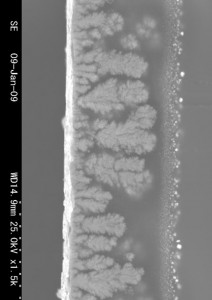
Eamex Lithium Polymer Capacitor Electrode. Click image for more info.
This seems to be a case of using two technologies in one device. Its quite innovative, addresses problems in products that need much higher levels of power and if the original translation is correct should be a capacitor that charges very fast. Even if the charge and discharge rate are slow by capacitor standards that would be very fast by battery standards.
Eamex has not unveiled the details claiming it increased the specific surface area to 20,000 times the existing value through the improvement of plating conditions. The plating improvements make it possible to significantly enhance the energy density. The company announced a capacitor with an energy density per unit volume of 100Wh/L back in December 2008, but the specific surface area was only about 1,000 times larger than that of existing electrodes. In any case the news story has cleared Japan’s Nikkei Business Publications. Should the surface area be a 20-fold increase in only a half year, the competition has to be taking notice.
Eamex readily admits that currently the capacitor’s high energy density cannot constantly be obtained saying, “Conditions must be optimized to achieve the 600Wh/L performance.” Still, the company claims that the energy density reaches 150Wh/L on average. Eamex has also reduced the internal resistance through the adjustment of plating structure and achieved a power density per unit volume of 20,000 W/L, which is much higher than that of the existing electric double layer capacitors. This is progress.
However, the latest prototype is extremely small, measuring only 0.2 x 0.5cm with a thickness of 31μm. Small photos are at the Eamex site. In order to commercialize the capacitor, its size must be increased and a stacked structure needs to be developed for larger capacity. So the company is promoting joint research efforts with other manufacturers that possess the related technologies.
Some of the leading Japanese automakers are reportedly strongly interested in this capacitor, which outperforms Lith-ion secondary batteries. Though Eamex did not state a specific schedule, it is, as the company says, “trying to expedite the commercialization.”
The news in this is the combined technologies of capacitors and batteries integrated into a single functioning device that successfully operates. Perhaps a commercial unit wouldn’t be so intensely energy rich, or later designs may well surpass today’s rating. But the hope of very fast charge rates for such things a personal transportation and portable computers are very enticing. This development could be the start of a new branch of storage, the “Batacitor” if I have it right, coined by fiction author Philip Jose Farmer decades ago . . .
I wish Eamex well, this form of technology has had runs at it before. And its time for a breakthrough success.
Comments
10 Comments so far
Feedburner
Reddit

Stumbleupon


I think the solution has been
around for a while !!
http://www.youtube.com/watch?v=PFcylXFGTgk
This mild stone does not even compare
to his achivement back in 2007 !
I like this data presented and it has given me some sort of inspiration to have success for some reason, so thank you.
Pretty nice post. I just stumbled upon your blog and wanted to say that I have really enjoyed browsing your blog posts. In any case I’ll be subscribing to your feed and I hope you write again soon!
Useful blog website, keep me personally through searching it, I am seriously interested to find out another recommendation of it.
This is really a extremely beneficial read for me, Have to admit you might be 1 in the most effective bloggers I ever saw.Thanks for posting this informative article.
It’s really a nice and helpful piece of information. I’m glad that you shared this helpful info with us. Please keep us informed like this. Thanks for sharing.
You got a really useful blog. I have been here reading for about an hour. I am a newbie and your success is very much an inspiration for me.
My husband and I were very happy that John managed to deal with his research from the precious recommendations he received from your very own web pages. It’s not at all simplistic to simply possibly be making a gift of helpful hints which often many people might have been making money from. Therefore we do understand we now have you to give thanks to because of that. The most important explanations you made, the straightforward site menu, the relationships you aid to promote – it’s got many terrific, and it’s really leading our son in addition to the family to recognize that this idea is worthwhile, and that’s very vital. Thanks for all!
Almost all I can say is, I don’t know what to express! Except needless to say, for the amazing tips that are shared on this blog. I will think of a zillion fun strategies to read the reports on this site. I do think I will ultimately take action with your tips on those things I could never have been able to deal with alone. You are so careful to allow me to be one of those to profit from your helpful information. Please know how great I am thankful.
Thanks for the information that I found your blog on Google. He is now in on a daily basis.