Oct
6
Electricity Directly From Sugar
October 6, 2009 | 8 Comments
Brigham Young University researchers have developed a fuel cell, the type as a battery with a fuel tank – that harvests electricity from the carbohydrates of glucose and other sugars. Glucose one might note is one of the human body’s preferred fuels.
BYU chemistry professor Gerald Watt says, “Carbohydrates are very energy rich. What we needed was a catalyst that would extract the electrons from glucose and transfer them to an electrode.”
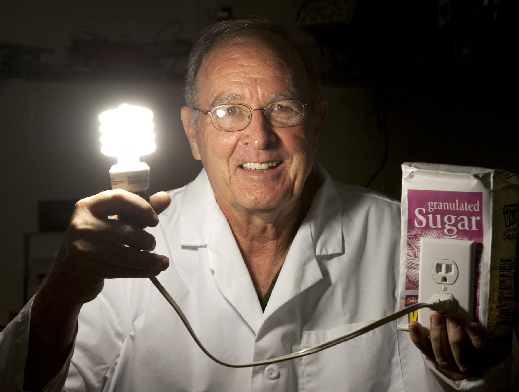
Gerald Watt Uses Sugar and Viogen to Generate Electricity
The catalyst chosen is from the chemistry family of the common weed killer Paraquat. Paraquat is the most commonly seen form of the chemical family of viologens. Viologens have been investigated for use in electrochromic systems and in a solution of sodium sulfate can be reduced at the cathode with the simultaneous formation of hydrogen gas.
Using a mildly alkaline solution as reported by Watt and his colleagues in the October issue of the Journal of The Electrochemical Society have sourced electrical energy showing a path directly from common carbohydrates to electrical power. Watt incidentally is the great-great-nephew of James Watt, the inventor of the steam engine.
This is quite an achievement. Watt and his colleagues built a rudimentary fuel cell utilizing viologen catalysts using glucose or dihydroxyacetone as fuels that demonstrated electrical power production at up to 20 mA/cm2 superficial current density. Improved catalyst function and cell design should significantly advance the efficiency and viability of direct carbohydrate fuel cell technology as a means of generating electrical energy from renewable biomass.
The study reports experiments that yielded a 29 percent conversion rate, or the transfer of 7 of the 24 available electrons per glucose molecule, an almost astonishing number for a first generation experiment. Compared to power chain such as growing plant sugar to ethanol to internal combustion, then electrical generation and a motor is already far far behind Watt’s fuel cell in efficiency and capital investment. Watt’s fuel cell is a major discovery.
Dean Wheeler, lead faculty author of the paper and a chemical engineering professor in BYU’s Fulton College of Engineering and Technology says in an understatement, “We showed you can get a lot more out of glucose than other people have done before. Now we’re trying to get the power density higher so the technology will be more commercially attractive.”
Hold on to your seat, since they wrote the paper, the researchers’ prototype has achieved a doubling of power performance. And they’re pursuing an even stronger sugar high. The next step for the BYU team is to ramp up the power through design improvements.
Inventing a direct to electricity carbohydrate fuel might seem a little odd, but as the researchers are reporting the efficiency is simply outstanding, and this is at the very beginning of the story. What are missing are the byproducts information (is there any free hydrogen?) and the other sundry details such as the quantity of the viogen used, its cost in energy to be produced and the amount of release yielded from it. But Paraquat is a dirt-cheap herbicide, used world wide and not particularly nasty stuff that is made across the globe.
Of great interest will be the power output numbers in volts and amps. Just how a system can be designed, the design choices, fueling processes such as a liquid or a solid fuel fill. Then one has to wonder where the research might go, sugars are just one bio thing, there is whole lot of other biomass products out there as well. This might be a first beachhead on a very long research journey with incredible potential.
Comments
8 Comments so far
Feedburner
Reddit

Stumbleupon


nio
no no no no no no no fail
What you said made a ton of sense. But, consider this, what if you were to create a awesome
headline? I mean, I don’t want to tell you
how to run your website, however what if you added a headline that makes people want more?
I mean Electricity Directly From Sugar | New Energy and Fuel is a little plain.
You should peek at Yahoo’s front page and see how they create news titles to get viewers interested.
You might try adding a video or a pic or two to get readers
excited about what you’ve got to say. Just my opinion,
it would bring your blog a little livelier.
Hi! I know this is kind of off topic but I was wondering if you knew
where I could find a captcha plugin for my comment form?
I’m using the same blog platform as yours and I’m having problems finding one?
Thanks a lot!
This is a good tip especially to those new to the blogosphere.
Simple but very accurate information… Thanks for sharing this one.
A must read article!
Heya i am for the first time here. I found this board
and I find It really useful & it helped me out much.
I hope to give something back and help others like you helped me.
Pretty! This has been a really wonderful post. Thank
you for supplyiung these details.
fantastic points altogether, you simply gained a
logo new reader. What would you recommend in regards to
your publish that you just made some days ago? Any certain?