Jun
13
How Much at What Pressure and Temperature?
June 13, 2008 | 37 Comments
The American Petroleum Institute had me out for a tour of the premier oil refinery in the U.S. Located out or up in Billings Montana, depending on where you are, this refinery is in a truly beautiful and picturesque location smack in the middle of a mid sized city. It’s an easy walk from the downtown area to the front entrance. You might be thinking, “What were they thinking?” putting such a thing in the middle of town, along the scenic and pristine Yellowstone River. Well it was 1949 . . .
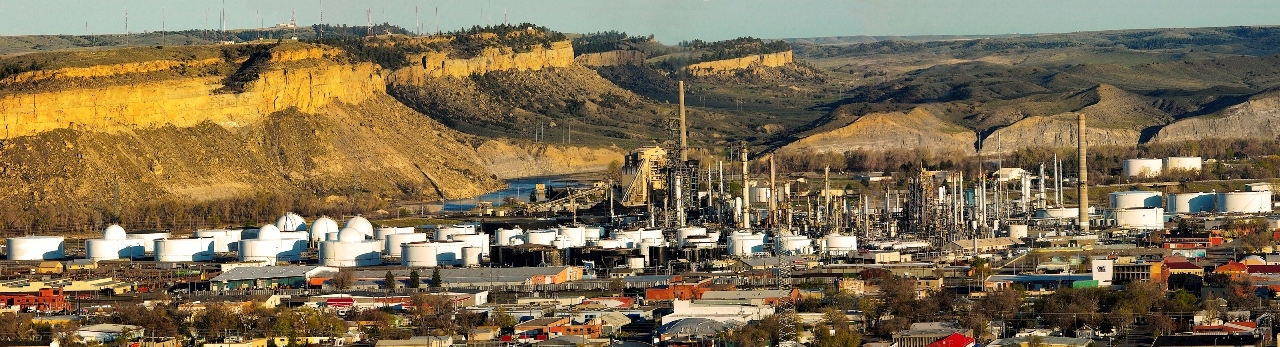
The refinery is the ConocoPhillips Billings Unit. It runs about 50+ thousand barrels a day, not real small nor is it a behemoth. The most striking thing coming up on it is – it doesn’t smell. If it does, its being overwhelmed by the livestock market not far away that offers much more powerful aromas. You might say that Billings smells of money. In truth though, the yards are full of cattle, so it’s not like hogs, fish or a poultry facility. What struck me, with my experience is more than the lack of aromas, was that the refinery was calm, clean, relaxed and running at full tilt. The staff knows what they’re doing here. It’s more than that though.
The management at ConocoPhillips is a little different than say Chevron or ExxonMobil. ExxonMobil, which while everyone likes to diss them, is the world’s leading engineering oil and gas, refining and petrochemical company. That sort of explains the psychology there. Chevron based in California is more adventurous, out going and involved, looking into everything, may have a little attention deficit – certainly has a little West Coast bend in its thinking and corporate culture. ConocoPhillips is a more Oil Patch company, which means they are more middle American, conscious of the neighbors and engaging in the community. Little differences like that have major effects outside of the companies themselves and our views of them.
Starting in 1990 ConocoPhillips went so far as to setup citizen advisory councils at its refinery complexes. These groups are the organized connection to the neighbors with the refinery complexes. With such a group, regular folks can participate, get access, and meet leaders that affect their lives and affect them back. With such a potential offered by refineries in a community from great paying jobs and investments, over to the reality of a huge volatile and inflammable concentration of fuel products, involvement is an important thing.
The night prior to the tour found we bloggers at a little dinner party with ConocoPhillips managers and members of the Citizens Advisory Council. Middle America with a western tint. These people, with divergent views are very relaxed and comfortable with each other. Its easy to see with such a sense of purposeful camaraderie, that keeping an important facility in top operating order that plays a major regional role running so well that it wins national awards isn’t so hard when the personal influences are so dignified and respectful of one another. Maybe it was the food, but that was a very nice dinner party, and offers that major plant operations can have extraordinary relations with the neighbors.
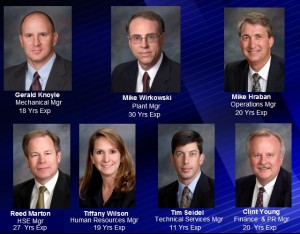
The tour was mostly in the “learning center” outside of the refinery itself. It was SAFETY SAFETY SAFETY from Reed Marton.
The tour itself was from inside a van type limo as letting a bunch of people out to run about in such a place isn’t a good idea at all. Lots of stuff in a refinery is very hot, from below air ambient to over 1000 degrees Fahrenheit and the flammable products are from bituminous high sulfur crude oil (not especially ignitable) all the way up to pure hydrogen gas at over 1300 psi pressure (extremely ignitable). I was happy to be in the van, close enough, as I have a good idea what that product range means and the results if an ignition source meets oxygenated fuel.
The impression I took away was that the plant is in as close to perfect shape as one could want. As noted, the aromas were weak if noticeable at all. The ship shape condition would do a nasty Admiral proud, not but one spot where something gooey had escaped over the edge of a tank ever so slightly to make a stain in the paint. And clean, you couldn’t possibly think this facility is 49 years old. It’s so efficient that it won an EnergyStar award twice. The guy every headhunter wants, that takes care of this bewildering array of fracture units, catalytic cracker, coker, tubing, storage, hydrogen production, and even a steam driven electrical generator from excess steam energy is Gerald Knoyle.
Keeping the whole thing in order is Mike Wirkowski, the plant manager who is soon to be lost to a ConocoPhillips refinery in England. Mike has the ideal personality and character to handle the tensions of a refinery in the middle of town. He will be missed I’m sure, but the people staying will surely support and bring the next manager up to speed in what must be one of the best working environments for a manager imaginable.
 The other bloggers are Bruce “McQ” McQuain, a favorite of mine both on the net and even more in person. Here is his take on the trip at www.qando.net/mcq.aspx. Next is Courtney Carlisle, young, smart, confident, and way cute, she writes at greenoptions.com which is a collection of writers that kindly put covers lots of turf.
There was also a team from Stanford’s smartenergyshow.com led by Clay Hamilton and with Luke Leaver, a bright impressionable young man from New Zealand. They were busy getting videos of everything, as Mr. Hamilton is an accomplished producer, until we got inside the refinery only to learn that an unidentified threat to the refinery was in investigation and everything photo and video was restricted until the threat had been closed. It would have been great to get more than the few shots they were allowed with the guide’s commentary. But I kind of think Clay is sharp enough to get something good, and the guide, Andy Holman is a sharp one too, and offered a great deal of information that would be highly educational when the Stanford site gets it up.
It was a very quick trip. Fly, dinner, sleep, Stella’s (OMG! The bakery for morning diet destruction!) training, tour, fly. If it weren’t for the weather and airline operations I would have been gone about 30 hours total. The API again provided the travel, lodging and food without cost to me, so that’s disclosed, but the PowerPoint presentation linked above and when the Stanford team posts video, that money will be well spent getting America’s best example of an oil refinery out to anyone interested in learning what the current best standards are and where other refineries are inexorably headed.
There are three other people who need credited, Jane Van Ryan of the API, her aide from Edelman, Kate Shirley, and ConocoPhillips’ own John McLemore who showed the grace and courtesy of the very refined southern gentleman. To this trio I give a thank you both of my own and for all of you, too.
Comments
37 Comments so far
Feedburner
Reddit

Stumbleupon


Looks like the utopia of oil refining. Good information; will check out the Smart Energy vlog once it hits the site.
[…] Brutus trip due to the airline letting him down, and a student, Luke Leaver from New Zealand on the Conoco Phillips Billings Refinery tour. Somehow Professor Gerritsen managed to assemble the flash movie with a little handheld Canon […]
Great post! Just wanted to let you know you have a new subscriber- me!
[…] How Much at What Pressure and Temperature? […]
[…] How Much at What Pressure and Temperature? […]
I read a few topics. I respect your work and added the blog to my favorites.
Are you a professional journalist? You write very well.
I wanted to thank you for this excellent read!! I definitely enjoyed every little bit of it. I have you bookmarked your site to check out the new stuff you post
I found this page via google, and it explains what I was trying to figure out. Thanks!
Thanks!! Very helpful post!
Frequently have I observed users deface wonderful websites such as this. It’s truly an atrocity. I merely want you to know that I entirely support your mission regardless of what those awful spammers might do next. Best Regards, Art Zavacky
i love reading your website
I enjoyed reading your blog. Keep it that way.
Really interesting information. I’m glad I found this post. Thanks for sharing
thank you for sharing with us,i like it very much and i will always give attention.
I am coming again dude. thanks for your great post
I love to comment on your blog sir
Do you have twitter account sir ? So i can follow your blog
Useful info. Thanks, very useful indeed…
No one can formulate articles as stunning as this ?! I’m truly in adoration of your talent that we cannot depict with english .. All your general loved ones must be wonderfully elated with your donations to the authors’ niche and we’ll forever bookmark your writing !
Like the site , just responding to the great comments on wordpress and the plug ins.Qualitity content is still the way to go.
wow this is really good site . i love to comment here . Thank you dude
Your website has to bring you money and this is why we have developed GetGoodLinks. This system helps you put your sites to work as you can use them to publish links and reviews. As for optimizers, they have a unique opportunity to increase the link volume by using Getgoodlinks.Advantages of GetGoodLinks: * All reviews are created by webmasters. Optimizers should only provide them with a task * Reviews and contextual links are being posted manually on a permanent basis * All websites included in Getgoodlinks are strictly moderated. Only reputable websites that are not used to trade links are accepted to the system
This a informative great read by the author looking forward to read more very soon.
Best you could make changes to the page title How Much at What Pressure and Temperature? | New Energy and Fuel to more generic for your blog post you make. I loved the blog post withal.
If you are open to having a guest blog poster please reply and let me know. I will provide you with unique content for your blog, thanks.
Thanks for some quality points there. I am kind of new to online , so I printed this off to put in my file, any better way to go about keeping track of it then printing?
Fascinating read. There is certainly currently quite lots of data close to this topic all around and about on the net and some are most defintely far better than others. You could have caught the detail here just proper which makes for a refreshing change – thanks.
I love individuals that who blog regularly, it is really tough to get that method of perception any other means. Wonderful work.
I like natural material, I cogitate this has some really fantastic info regards .
Hello, this is my first time i visit here. I found so many interesting in your blog especially on how to determine the topic. keep up the good work.
I like this blog site and have book marked it. I‘ll turn to read in information on my holiday
Good! Thank you! I always wanted to write in my site something like that. Can I take part of your post to my blog?
Nice post! You truly have a wonderful way of writing which I find captivating! I will definitely be bookmarking you and returning to your blog. In fact, your post reminded me about a strange thing that happened to me the other day. I’ll tell you about that later…
Hello there, grateful i found your site. It solved the problem to learn this issue a bit better.
Hi, I do think this is an excellent web site. I stumbledupon it 😉 I
will revisit once again since i have book marked it.
Money and freedom is the best way to change, may you be rich and continue to guide
others.
Climate changes, hot become hotter everywhere.